Martin Bullock (Robvil)
Bothaville/Viljoenskroon082 921 0887


Martin Bullock (Robvil)
Bothaville/Viljoenskroon


MENU


By Petrus van Rooyen, sales manager: forage crops, Pannar Seed
More and more producers are planting cover crops to improve soil fertility and health, and are experiencing the benefits of this first hand. Pannar is receiving more and more inquiries regarding products that can be used as cover crops for conservation agricultural practices.
Conservation agricultural practices
The overall goal of these practices is to better hedge farms against risks and to preserve our land for future generations. One of the starting points is having a diversity of living roots in the soil throughout the year on which soil microbes can feed. In this way, the activity and biodiversity of the microbial population is supported and increased.
Cover crops make a major contribution to conservation agriculture by maintaining and protecting soil health, soil productivity and profitability. Over time, soil aggregation tends to improve with the addition of organic matter and increased soil microbial activity. Other conservation benefits of cover crops include erosion control, nitrogen fixation and weed suppression. It is also an excellent feed source for animals.
Cover crop mixtures
The composition of cover crop mixtures is important, as each included crop offers a specific advantage and must be adapted to the region where it is planted. Summer and winter mixture will therefore differ from one another.
A mixture can include root crops, Brassicaceae crops, winter and summer grasses, and nitrogen-fixing legumes. When recommending a cover crop mixture, it is important to keep in mind the soil type, the growth pattern of different crops, and the seed size and density of each crop. This is so that maximum benefit can be derived from the mixture.
Cover crop mixtures can be broadly divided into three groups, namely summer mixtures, winter mixtures and crops that are planted or sown between grain crops such as maize, later in the season. Examples include Japanese radishes, forage cereals, cowpeas, ryegrass and lucerne.
Winter cover crops
Where summer crops are cultivated and sufficient moisture is available, a winter mixture can be planted as soon as the first summer crops have been harvested. Ryegrass, Japanese radish, oats, triticale and stooling rye are recommended for this purpose. With the exception of ryegrass, the other crops are fairly hardy and drought tolerant. Radishes and forage cereals present many advantages for a crop rotation system that includes other crops.
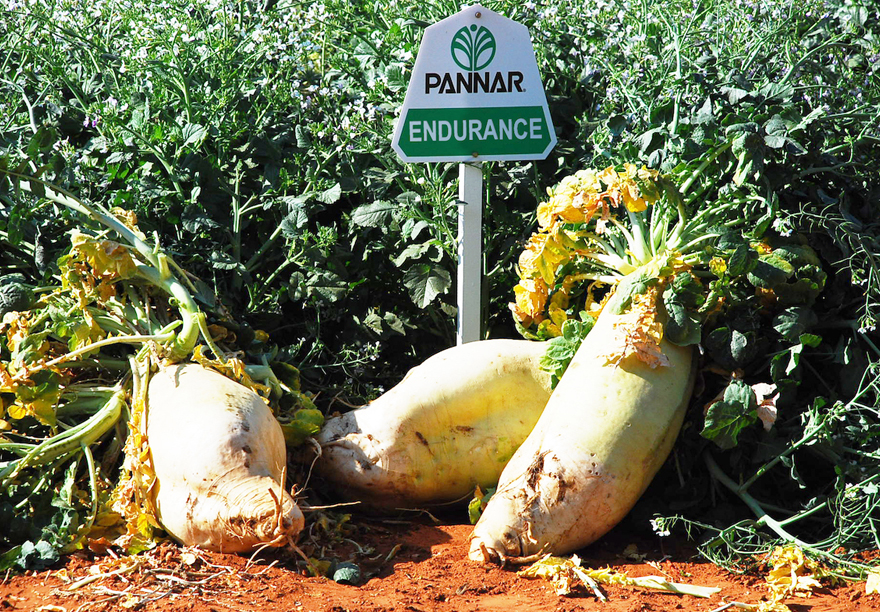
Japanese radishes and all the cereal forage crops such as stooling rye, triticale and oats grow actively in autumn, through winter or until early spring. Radishes grow strongly from March to mid-August and provide good grazing for livestock. Japanese radishes produce large tubers and leaves, helping to protect soil from erosion. In addition, the taproot helps to break up shallow compaction layers and ploughsole, promote water penetration and improve root development of the follow-up crops.
Oats, stooling rye and triticale provide excellent autumn and winter grazing. Forage cereal cultivars are divided into winter, intermediate and spring types according to their cold requirements. This also determines when the cultivar should be available for grazing. Forage cereal’s normal planting time is February to April. Because intermediate types’ cold requirements are less, they can be planted until May, while spring types that do not have a cold requirement, can be planted until the beginning of August, provided that enough moisture is available.
Ryegrass is divided into Italian and Westerwold types. Italian types can be planted either in autumn or spring, with outstanding autumn and spring production. The Westerwold types are established during early autumn and produce feed from mid-winter to October, if sufficient moisture is available.
Summer cover crops
Summer cover crops are planted in rotation with grain crops. Relevant crops include the different forage sorghum hybrids, teff and lucerne. Forage sorghum hybrids differ in their regrowth ability, yield potential and sugar content. This determines whether the crop is suitable for a grazing system and whether it should be allowed to regrow after the first grazing, so that it can be used as standing hay or silage.
For more information, email Petrus van Rooyen at petrus.vanrooyen@pannar.co.za.


 Farmer Stories
 News
News