Duwal Edwards
East London083 228 5951


Duwal Edwards
East London


MENU


By Johann Botes, Representative, Lichtenburg, Pannar Seed
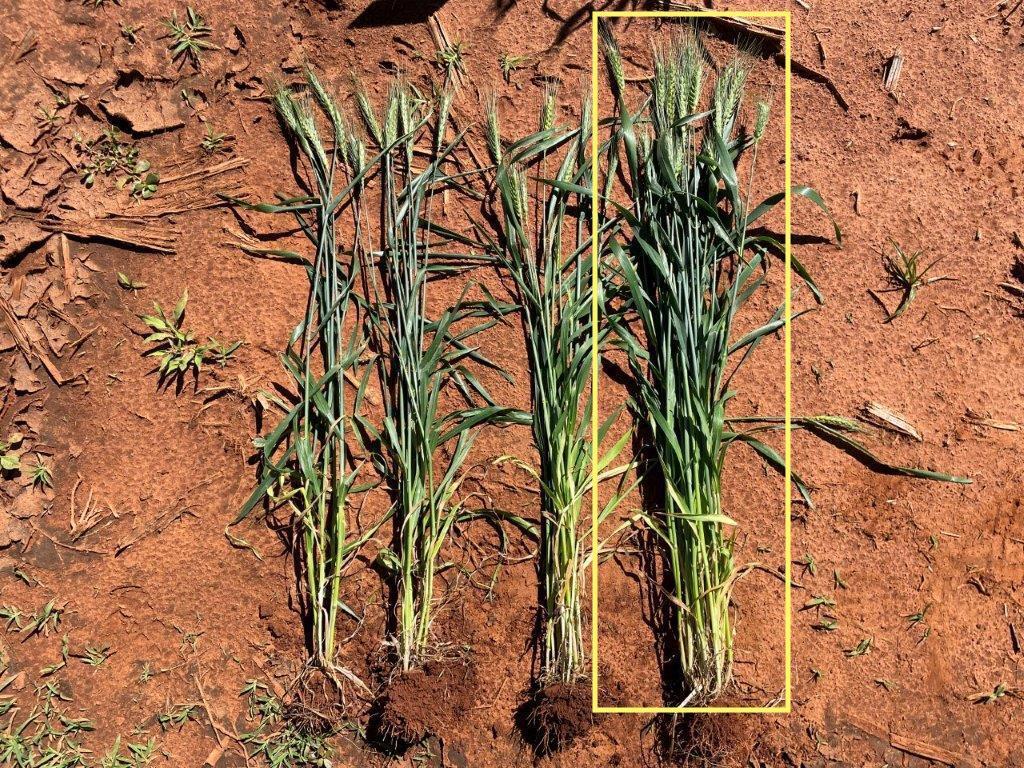
"A lower plant density works with Pannar's spring type wheat cultivars", says Johann Botes, Pannar's representative in Lichtenburg. This photo demonstrates Pannar's spring type wheat cultivars' strong tillering (stooling) capacity at JP Strydom’s farm in the Lichtenburg district.
.jpg)
PAN 3497 on the far right with 11 - 19 tillers, was planted at 88 kg seed/ha. To the left is another spring type cultivar planted at 112 kg seed/ha that produces 5 - 7 tillers. The lower plant density has several advantages for the producer. If Pannar's spring type wheat cultivars are planted early, they can be planted at a lower plant density because of their good stooling capacity. However, if the planting time shifts to the second half of the recommended planting window for the cultivars, up to 100 kg of seed per hectare is recommended.
At early planting dates under irrigation, the recommended planting density of Pannar's cultivars is three bags of seed (75 – 80 kg) per hectare. Lower plant densities are recommended to exploit the cultivars' maximum yield potential. Combined with a good seedbed and a reduced seeding rate, 170 to 180 plants per square meter should establish at a germination percentage of 90%.
The first obvious advantage is the reduction in seed costs per hectare. The second benefit is the potential increase in yield, as measured over several seasons in Pannar’s wheat trials. Several factors contribute to a yield increase.
At low plant densities there is less competition in the row between plants. This enables each individual plant to reach its full stooling capacity. As a result, the stronger plants can form better and deeper roots and each “plant factory” can therefore build up a larger storage capacity that can be used later in the season at grain filling.
As the tillers develop at different times they do not flower at the same time. This gives the plant a built-in buffer against a one-off cold spell that can damage the seed heads. This protects the yield. Plants at a lower plant density can escape cold damage to a large extent. The tillers not damaged during an unexpected cold period can, to a large extent, compensate for the loss in yield.


 Farmer Stories
 News
News