Franna Joubert
Middelburg083 388 2617


Franna Joubert
Middelburg


MENU


Small grain forage cereal crops such as oats, stooling rye and triticale produce excellent forage in the crucial autumn, winter and spring months if enough moisture is available. Sorom is a spring type stooling rye that can produce an abundance of feed in the tough late winter/early spring months.
When choosing a forage cereal cultivar, it is important to know what the cultivar’s cold requirements are. Cultivars are divided into winter, intermediate and spring types according to their cold requirement to vernalize (go to seed). The cold requirement of a cultivar gives an indication of when it should be planted and determines when the cultivar should be available for grazing. Forage cereals are normally planted from February to April. By knowing the cold requirement of the cultivar, we can optimize the planting date and utilization period as a pasture.
Winter forage cereals have a high cold requirement before it will proceed to seed formation (vernalisation). They must be exposed to cold conditions for a long period before seed production is initiated. For seed production, this group of cultivars should be planted in late autumn or early winter to meet the cold requirements of the crop. The name “winter type” is therefore derived from the planting time for grain production. These cultivars all develop at a much slower rate than the spring and intermediate types but sustain their role by providing grazing in the harsh late winter and early spring months. Winter type green forage crops should preferably be planted in soil with good moisture retention capacities. This will ensure that there will be enough soil moisture available in August, in the summer rainfall areas, to enable regrowth after grazing.
Intermediate forage cereals fall into a growth class between the spring and winter types. This group’s cold requirements vary from a low to a high cold requirement. Intermediate cultivars will not proceed to the flowering stage as readily as the spring type cultivars. Intermediate cultivars stool or tiller readily. The intermediate types initially develop quicker than winter type cultivars. As intermediate types have a lower cold demand than winter types, they can be planted until May.
The intermediate and winter types are the growth classes most suitable for use as green forage crops. Fair to excellent regrowth can be expected from these cultivars after grazing if adequate moisture is available. Spring type forage cereal crops, on the other hand, are normally planted as grain crops. Sorom is an exception and an excellent choice as a forage cereal.
Spring type forage cereal cultivars do not require a period of cold (vernalisation) to set seed but are daylight sensitive. They will progress to the flowering stage when day length increases and is long enough for this purpose. If planted too early in the season, they will start to flower before winter. These cultivars are planted in early spring for grain production in the summer rainfall areas to avoid frost damage during the flowering stage, hence the name “spring type”. Cultivars in this growth class do not normally stool well and tend to have an upright growth habit. In general spring types are mostly used for grain or silage production but can be used for a once-off grazing if grazing is urgently needed.
Sorom, a stooling rye cultivar developed in Germany, is a fast-growing spring type stooling rye that produces excellent dry material yields. Planting time is from April to late July. If enough moisture is available Sorom is ideal to fill the late winter/early spring forage gap.
The recommended planting density for Sorom in rows is 45 kg to 50 kg seed per hectare on dryland and 70 kg to 80 kg seed per hectare under irrigation. The planting depth should vary from 20 mm to 25 mm. Because the cultivar tillers or stools slightly less, the plant density is increased so that feed will be produced in larger quantities. This is especially true for late plantings.
Sorom was bred in very cold conditions in the north of Germany and has excellent cold tolerance. In comparison the growth of oats can be severely retarded in very cold conditions, Sorom on the other hand will continue to grow actively.
As a spring type cultivar Sorom is a quick or a fast grower that tends to start flowering and go to seed in early spring (mid-September). After that, it will no longer be palatable, while it’s carrying capacity also decreases rapidly. Sorom must therefore be grazed early to make optimal use of it.
Sorom has the same tendency as rye and is not well adapted to heavy soils with a clay content of more than 35%. It prefers and performs best on sandy soils.
Table 1: Pannar offers a versatile forage cereal package to fill the critical autumn/early winter and late winter/early spring months.

Contact your Pannar sales representative for more information and recommendations regarding Pannar’s comprehensive forage crop package.
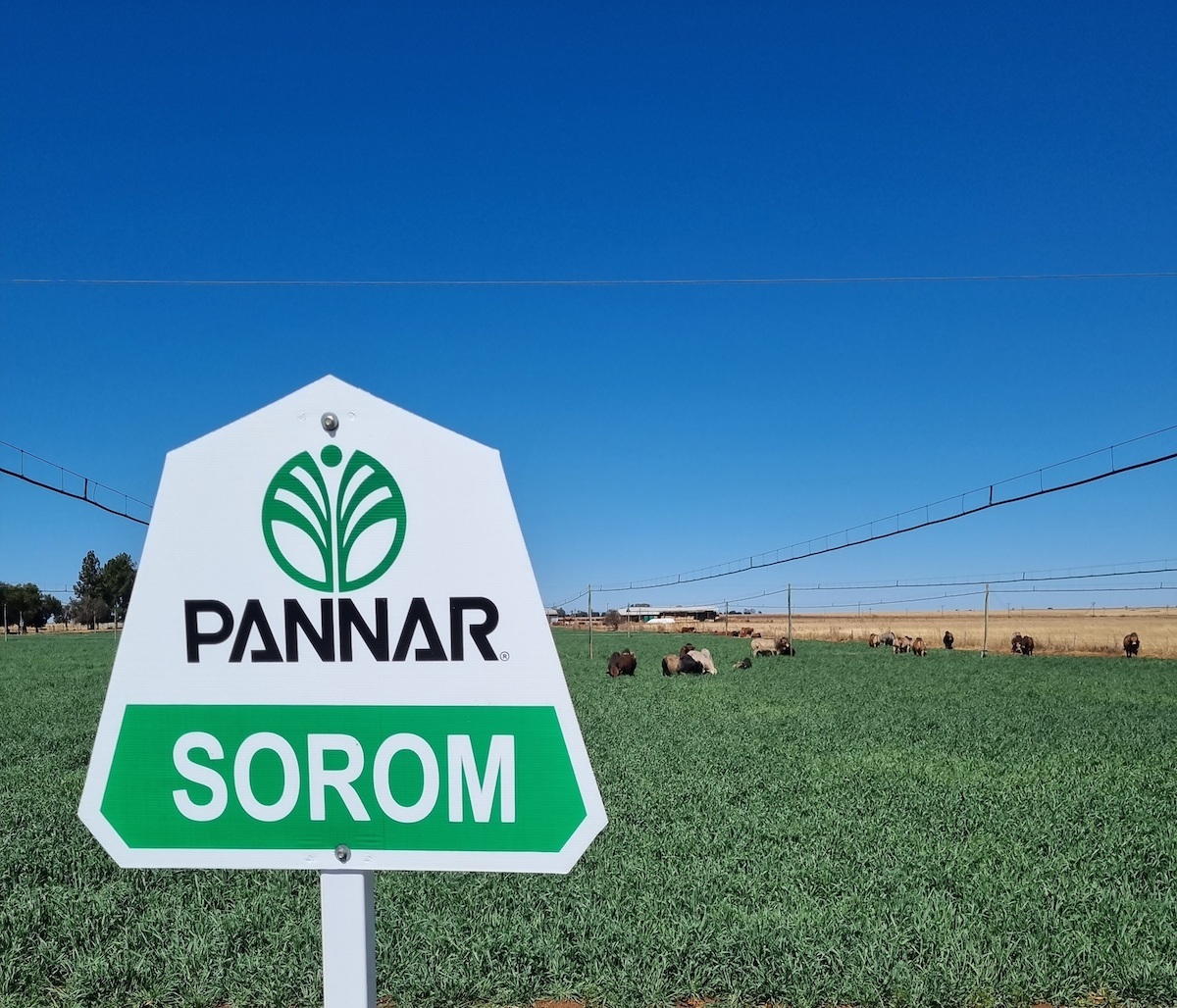
Pieter Geldenhuys Pannar’s sales representative in Ventersdorp shared this beautiful planting of Sorom that was being grazed in August and September.


 Farmer Stories
 News
News